Pamukkale and Hierapolis: The Complete Guide to Türkiye’s Cotton Castle
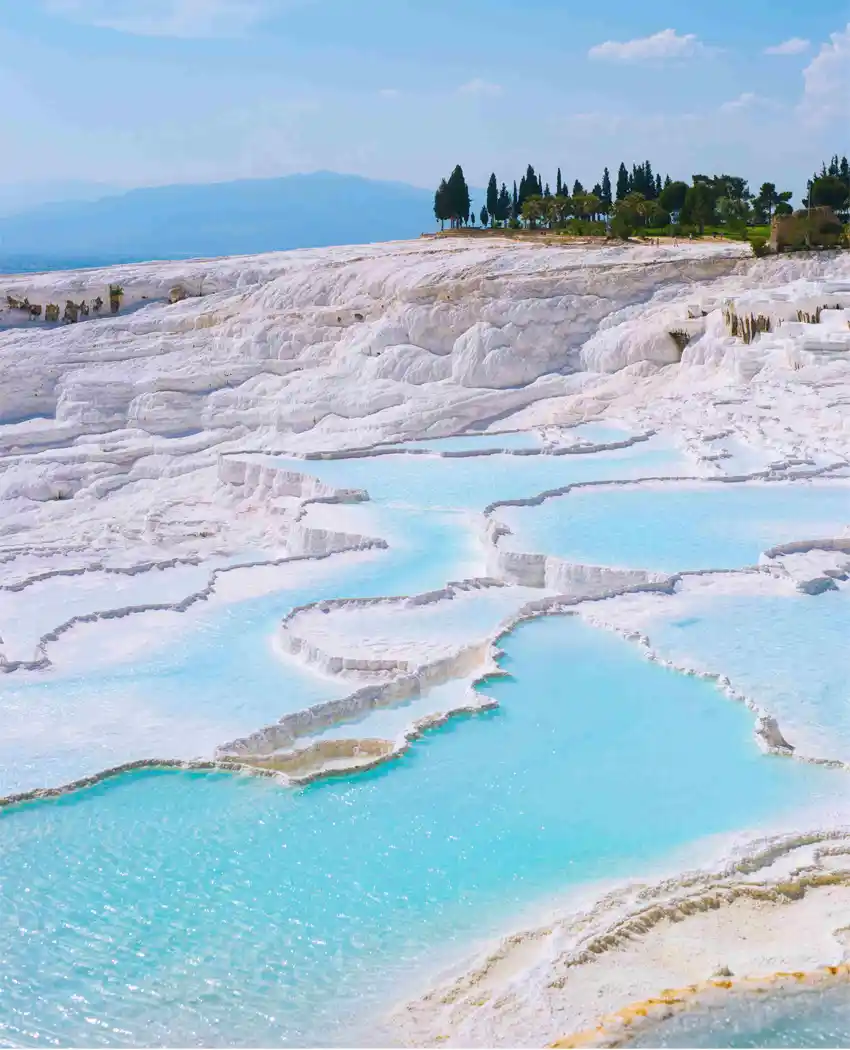
From a distance, the hillside above the village of Pamukkale looks as if it has been covered in snow, even in the middle of summer. Up close, the white is made of travertine: terraces of calcium carbonate left by warm, mineral-rich springs flowing down the slope for thousands of years. On top of this natural wonder lie the ruins of Hierapolis, a Greco-Roman spa city where people came to heal, to worship and to be buried. Together they form one of Türkiye’s most remarkable UNESCO World Heritage Sites. This Pamukkale travel guide explains how to visit, what not to miss and how to combine it with nearby sites.
What is Pamukkale?
“Pamukkale” means “cotton castle” in Turkish, a perfect description of the white cliffs. The thermal water emerges at about 35°C, and as it cools and releases carbon dioxide, calcium carbonate settles and hardens into terraces and shallow pools. The process continues today, which is why the authorities carefully manage where visitors can walk. Pamukkale and Hierapolis were inscribed together on the UNESCO World Heritage List in 1988.
Walking on the travertines
A path crosses the travertines from the lower village to the top. To protect the surface, shoes are not allowed: you walk barefoot on the warm, slightly rough stone and through shallow pools of water. It is an unforgettable feeling, especially at sunset when the terraces turn pink and orange.
- Bring a small bag for your shoes and a towel for your feet.
- The surface can be slippery where the water flows and a little rough elsewhere; walk slowly.
- Swimwear is common in the pools, but modest clothing is fine too.
- Sunglasses are essential: the white reflects strong light.
Exploring Hierapolis
Founded in the 2nd century BC by the kings of Pergamum, Hierapolis grew into a prosperous Roman city known for its healing waters. Many of its monuments are still standing:
The theatre
The beautifully restored Roman theatre could seat around 12,000 spectators and still has decorated reliefs on its stage building. The view over the plain from the upper rows is superb.
The necropolis
Hierapolis has one of the largest ancient cemeteries in Anatolia, with hundreds of tombs, sarcophagi and tumuli stretching along the northern road. It reflects how many visitors came here hoping to be cured, and how many stayed forever.
The Martyrium of St Philip
On a hill east of the city stands the octagonal Martyrium built in honour of the apostle Philip, who according to tradition was martyred in Hierapolis. In 2011 archaeologists identified a tomb in a nearby church as the probable tomb of the apostle. For Christian groups, this is a deeply moving stop and pairs naturally with the Seven Churches of Revelation.
Frontinus Street and the gates
The main colonnaded street runs between the Byzantine North Gate and the elegant Domitian Gate with its three arches, giving a strong sense of the city’s scale.
The Antique Pool
Often called “Cleopatra’s Pool”, the Antique Pool is a thermal pool where you can swim among fallen marble columns that tumbled in an ancient earthquake. The water stays warm all year. There is a separate entrance fee, and it can be busy at midday.
Hierapolis Archaeological Museum
Housed in the former Roman baths, the museum displays statues, sarcophagi and reliefs from Hierapolis and nearby sites. It is small but well worth half an hour.
Laodicea, the neighbour city
Just a few kilometres away lies Laodicea, one of the seven churches of the Book of Revelation and today one of the most active excavations in Türkiye. Its colonnaded streets, two theatres and early church are impressive, and the site is usually much quieter than Pamukkale. Laodicea also helps explain the famous “lukewarm” verse: hot water flowed from Hierapolis, cold water from Colossae, and by the time water reached Laodicea it was neither.
How to get to Pamukkale
The nearest city is Denizli, about 20 kilometres away, with an airport (Denizli Çardak) that has flights from Istanbul. Pamukkale is also about three hours by road from the Ephesus area and roughly the same from Antalya, which makes it a natural stop on classic routes such as Istanbul – Ephesus – Pamukkale – Cappadocia. Many of our Türkiye tours include an overnight stay in Pamukkale’s thermal hotels.
Best time to visit and how long to stay
Spring and autumn are ideal. In summer, the white surface reflects heat and light, so visit early in the morning or late in the afternoon. Winter is quiet and the warm water feels wonderful in the cold air. Plan at least half a day for the travertines and Hierapolis, or a full day including Laodicea. Staying overnight lets you see sunset on the terraces and enjoy a thermal pool at your hotel.
Practical tips
- Entrances: The site has a lower (village) entrance and upper (south and north) entrances. Coaches usually use the upper gates, and you walk down the travertines.
- Sun protection: There is very little shade; bring water, a hat and sunscreen.
- Accessibility: Walking barefoot on the travertines can be hard for some visitors; Hierapolis can be explored on paths from the upper entrances.
- Combine wisely: Pamukkale works best as an overnight stop between Ephesus and Cappadocia.
Would you like Pamukkale, Laodicea and Hierapolis in your programme? Contact Mariposas Tour and we will build the route around your group.
Thermal hotels and wellness
The thermal springs that created the travertines also feed the spa hotels of Karahayıt and Pamukkale, a few minutes away. Many have mineral-rich pools, indoor thermal baths and traditional hammams, making an overnight stay a relaxing break in a busy itinerary. Karahayıt is famous for its red springs, coloured by iron, which you can see flowing into small pools in the village centre. In the evening, after the day visitors have left, the area becomes peaceful, and you can enjoy dinner with a view of the white cliffs lit up in the distance. For groups, these hotels are ideal: spacious, comfortable and used to welcoming international visitors. We often recommend staying here between Ephesus and Cappadocia so that travellers arrive refreshed for the long drive across the Anatolian plateau.
Frequently asked questions
Can you swim in Pamukkale?
You can paddle in the shallow pools on the travertines, and you can swim in the Antique Pool, a thermal pool with ancient columns, which has its own entrance fee.
Do you have to take off your shoes at Pamukkale?
Yes. Shoes are not allowed on the travertine terraces to protect them. Carry your shoes in a bag and walk barefoot.
Is one day enough for Pamukkale?
Half a day covers the travertines and the main sights of Hierapolis. A full day, or an overnight stay, lets you add Laodicea, the museum and sunset.
What is the closest airport to Pamukkale?
Denizli Çardak Airport is the closest, about an hour’s drive away. İzmir and Antalya airports are around three hours away.